





Although Rajinikanth last appeared in a Hindi film two decades ago, his on-screen presence remains electrifying, especially with his iconic multi-barrel gun scenes.
As Thalaiva approaches his 75th birthday on December 12, Dinesh Raheja reflects on his 17-year journey in Hindi cinema.
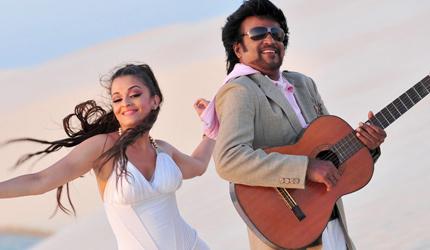
IMAGE: Aishwarya Rai Bachchan and Rajinikanth in Robot.
At 75, Rajinikanth is a cultural icon. Having achieved his greatest triumphs in Tamil cinema, his popularity spans the entire nation.
Few actors can boast such widespread appeal.
Even Shah Rukh Khan, Deepika Padukone, and Yo Yo Honey Singh paid homage to him in the 2013 Chennai Express hit song Lungi Dance, which begins with an acknowledgment from King Khan: ‘This is a tribute to Thalaivar.’
The television show Bahu Hamari Rajani Kant cleverly used his name, depicting a humanoid trying to integrate into a joint family. The colloquial term ‘Rajinikanth’ has become synonymous with strength and power.
The well-known Rajinikanth jokes celebrate his legendary capabilities.
These jokes, popular for years, praise rather than ridicule the star.
For example: ‘When Rajinikanth does push-ups, he isn’t lifting himself up; he is pushing the earth down.’
And another: ‘Rajinikanth gave Mona Lisa that smile.’
Rajinikanth’s iconic status is supported by several factors. In 2023, he was reported as India’s highest-paid actor. His Hindi-dubbed hits like Robot and its sequel 2.0 also attracted substantial audiences.
His Bollywood presence in the ’80s and ’90s, though only partly successful, laid the foundation for his nationwide recognition.
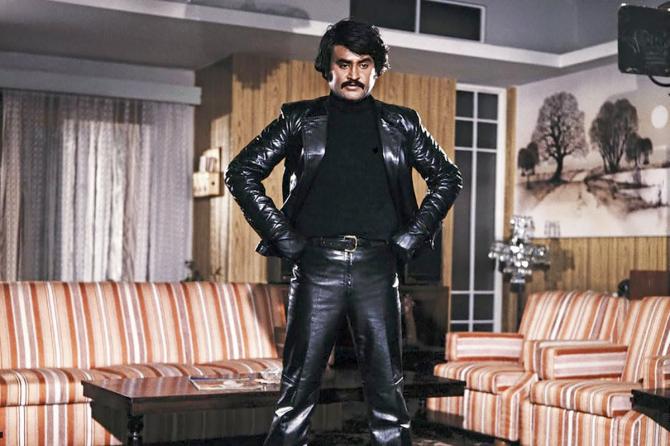
IMAGE: Rajinikanth in Andhaa Kaanoon.
At 32, Rajinikanth was already a prominent South Indian star when he debuted in Hindi cinema with the blockbuster Andhaa Kaanoon (1983). Born as Shivaji Rao Gaikwad to a Marathi-speaking family, he rose from being a bus conductor to a popular star through determination. He applied the same approach to Hindi films.
Andhaa Kaanoon featured Amitabh Bachchan in a significant appearance, but Rajinikanth gained new admirers with his distinctive style.
He showcased the daring techniques that earned him applause in the south, captivating Hindi audiences.
In his first action scene of Andhaa Kaanoon, Rajinikanth performed his famed ‘flipping the cigarette’ trick. The cigarette stayed in his mouth as he fought off several villains, taking puffs before extinguishing it on a defeated foe.
He soon executed his sunglasses trick, spinning them onto his nose with impressive skill.
In Andhaa Kaanoon, Rajinikanth’s character defied his police inspector sister (Hema Malini) to avenge their father’s murder, marking each victory with his signature sunglasses spin.
In another scene, Amitabh watched as Rajinikanth lit a cigarette by striking a matchbox against a matchstick. Such scenes contributed to the creation of Rajinikanth jokes.
A new mass hero emerged with Andhaa Kaanoon.
Rajinikanth could woo the heroine at the disco, deliver powerful dialogues, and express intense emotions.
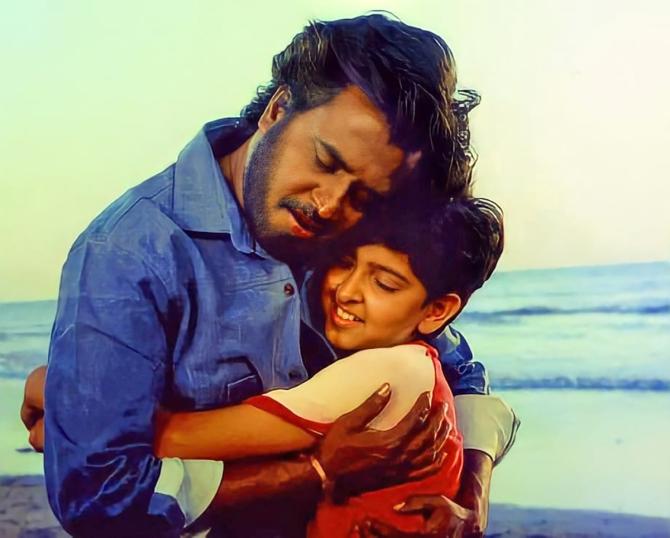
IMAGE: Rajinikanth and Hrithik Roshan in Bhagwan Dada.
Rajinikanth and Kamal Haasan (who had succeeded with Ek Duuje Ke Liye in 1981) became pioneers from the South. Many in the ’80s Hindi film industry believed they would challenge northern dominance and establish a place for South Indian actors.
While Kamal Haasan withdrew after Saagar (1985), Rajinikanth continued.
He achieved another hit with a triple role in John Jani Janardhan (1984), contrasting with Amitabh Bachchan’s less successful Mahaan (1983) triple role.
Throughout the next decade, Rajinikanth was a reliable box office draw. Films like Bhagwan Dada (1986) initially attracted audiences, regardless of their eventual success.
Action-packed films like Dosti Dushmani (1986), Asli Naqli (1986), and Insaaf Kaun Karega (1987) kept him in the spotlight.
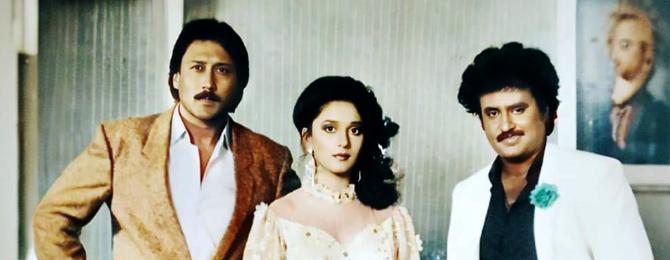
IMAGE: Jackie Shroff, Madhuri Dixit, and Rajinikanth in Uttar Dakshin.
Like much of ’80s cinema, Rajinikanth’s films were unapologetically commercial. He played to his strengths. In Mahaguru (1985), he impressed Meenakshi Seshadri with his sunglasses trick.
In Geraftaar (1985), alongside Amitabh Bachchan and Kamal Haasan, he repeated his cigarette trick, adding another success.
Rajinikanth starred with Sridevi in Chaalbaaz (1989), but she stole the show with her dual role.
He appeared with newcomer Madhuri Dixit in Uttar Dakshin (1987), but the film underperformed despite Subhash Ghai’s production.
He made a cameo in Ramesh Sippy’s Bhrastachar (1989).
Producers often cast Rajinikanth in special roles to boost commercial appeal, but this did not revive his waning Bollywood career.
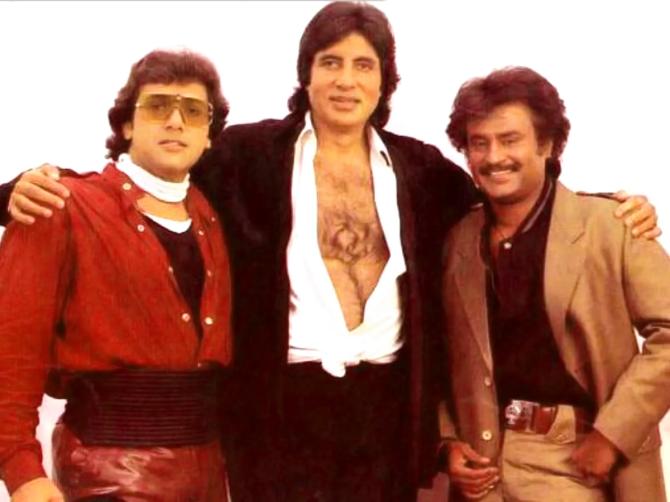
IMAGE: Govinda, Amitabh Bachchan, and Rajinikanth in Hum.
In 1991, Rajinikanth returned to form with four major Hindi releases. In the successful Hum, he played a policeman with emotional depth, clashing with his brother (Amitabh Bachchan) after his family is kidnapped.
In Phool Bane Angaarey, Rajinikanth’s character’s death inspires Rekha to seek vengeance.
His other 1991 releases, Farishtay and Khoon Ka Karz, were large-scale multi-starrers that did not succeed.
Afterward, Rajinikanth reduced his Hindi film roles.
He played a gangster with Aamir Khan in Aatank Hi Aatank (1995) and returned for a cameo in Bulandi (2000), which was his last Hindi film.
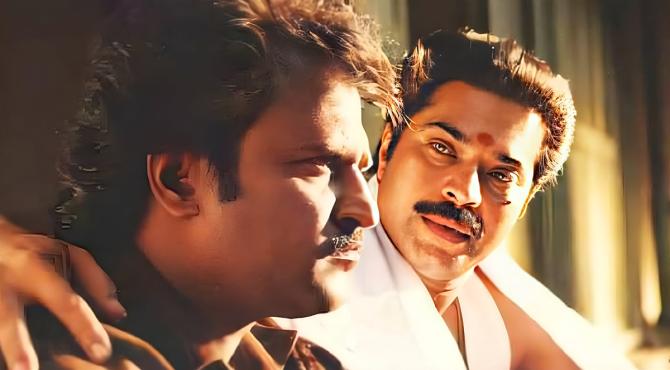
IMAGE: Rajinikanth and Mammootty in Thalapathi.
Rajinikanth’s decision to leave Hindi films after 28 movies and numerous hits was influenced by several factors.
His Tamil film career reached new heights in the ’90s with blockbusters like Thalapathi (1991), Baashha (1995), and Muthu (1995), elevating him to superstardom.
It made little sense for him to appear in ensemble Hindi films when offered substantial roles in southern cinema. His films even gained popularity in Japan by the decade’s end.
However, his connection with Hindi audiences endured, as shown by the reception of Hindi versions of Robot (2010) and its sequel 2.0 (2018).
Though his last Hindi film was two decades ago, Rajinikanth continues to captivate audiences with his dynamic performances.
Photographs curated by Satish Bodas/Rediff