





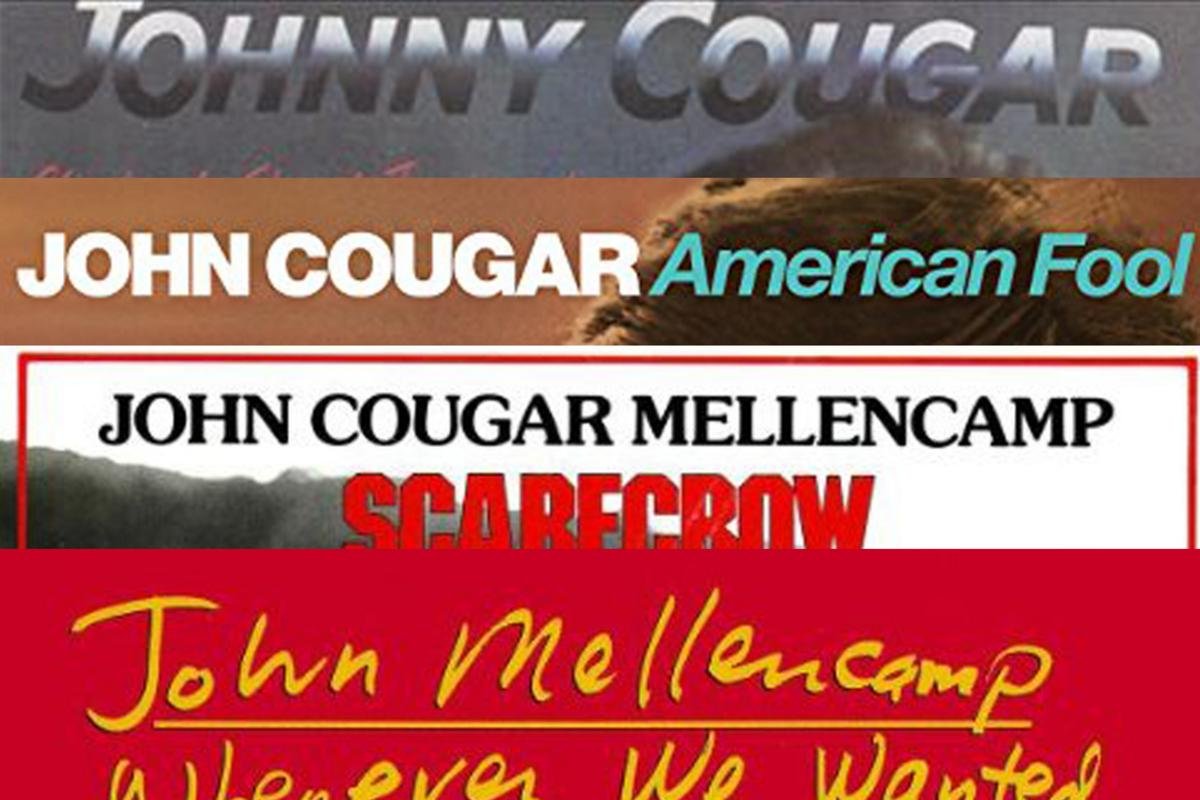
Early in his career, John Mellencamp faced a pivotal decision: adopt a new stage name and release his debut album with MCA Records, or return to his hometown of Seymour, Indiana, for a low-paying job. At not even 25, Mellencamp was presented with the alias “Johnny Cougar” as his ticket to potential rock stardom.
Mellencamp was hesitant. “No one’s ever called me Johnny in my life,” he remarked, unsure how to embrace the Cougar persona. He had been making regular trips from the Midwest to New York City, seeking music industry attention with little success until Tony DeFries heard his demo.
DeFries, who ran MainMan management with clients like David Bowie, Lou Reed, and Iggy Pop, was impressed by Mellencamp’s voice and James Dean-like appearance. However, he disliked Mellencamp’s last name, believing it wouldn’t sell records.
“We wanted something uniquely American, something hot and wild,” MainMan associate Jamie Andrews explained to Seventeen magazine. “Johnny Indiana, Puma, Mustang were considered – but nothing was as hot as Cougar!”
Mellencamp reluctantly agreed, signing to release his debut. “I would have signed anything – I would have signed the bottom of a shoe,” he told Rolling Stone in 2013.
Initially, the gamble didn’t pay off. His debut album, 1976’s Chestnut Street Incident, sold only 12,000 copies and was criticized as a weak Bruce Springsteen imitation. MainMan shelved his second album, The Kid Inside, and MCA dropped him.
Despite Mellencamp’s admission that the album wasn’t his best, he blamed the failure on DeFries’ over-hyping. DeFries had compared him to Bob Dylan, calling Mellencamp “the most American artist I’ve seen since Dylan.”
After being dropped by both MCA and MainMan, Mellencamp was left with a failed album, an unreleased record, and a “pretty silly” name.
Instead of abandoning the name, Mellencamp modified it to John Cougar, rejecting the “Johnny” moniker. He sought a name that wouldn’t drive him crazy.
“I was washed up and over by my mid-twenties,” he said. “But I knew if I delivered a song that could get on the radio, I had a shot.”
He signed with new management and recorded in England. A Biography wasn’t released in the U.S., but its single “I Need a Lover” became a hit in Australia, giving Mellencamp another chance at American success. The song was included in his next U.S. album, John Cougar, and became a modest hit, as well as a radio success for Pat Benatar.
“Managers always wanted to put their two cents in,” Mellencamp reflected in 2005. “But after the Johnny Cougar debacle, I rejected almost everything they said.”
Mellencamp retained the John Cougar name through his 1982 breakthrough album, American Fool, featuring hits “Hurts So Good” and “Jack & Diane.” The album and its singles topped the Billboard charts, bringing Mellencamp fame and a Grammy, though he still wasn’t using his real name.
DeFries attempted to capitalize on Mellencamp’s success by releasing The Kid Inside in 1983, seeking profit from new fans. It was the last album not to feature Mellencamp’s real last name.
With the success of American Fool, Mellencamp gained creative control, evident in the sound of his next album, 1983’s Uh-Huh, which featured the name John Cougar Mellencamp. Contrary to DeFries’ belief, many bought records from Mellencamp. Uh-Huh went multi-platinum with hits like “Pink Houses,” “Authority Song,” and “Crumblin’ Down.”
Though the “Cougar” name lingered, Mellencamp recorded the music he loved. Throughout the ’80s, he wrote personal and political songs, incorporating instruments like fiddle and accordion. Albums like Scarecrow, The Lonesome Jubilee, and Big Daddy went platinum, with hits such as “Lonely Ol’ Night,” “Small Town,” “R.O.C.K. in the U.S.A.,” “Paper in Fire,” and “Cherry Bomb.”
By 1991, Mellencamp fully reclaimed his name with Whenever We Wanted, released under John Mellencamp.
Since then, Mellencamp has recorded as himself, becoming a respected figure in rock. He continues to release music, tour, and support American farmers, while engaging in the visual arts. He’s been honored by ASCAP, the Americana Music Association, and inducted into the Rock and Roll Hall of Fame. Johnny Cash even praised him as one of music’s top 10 songwriters, a testament to his quintessentially American artistry.
Though DeFries wasn’t accurate in predicting Johnny Cougar as “the most American artist,” he was close when it came to John Mellencamp.



My programmer is trying to persuade me to move to .net from PHP.
I have always disliked the idea because of the costs.
But he’s tryiong none the less. I’ve been using
WordPress on a variety of websites for about a year
and am nervous about switching to another platform. I have heard excellent things about blogengine.net.
Is there a way I can import all my wordpress content into it?
Any kind of help would be greatly appreciated!