





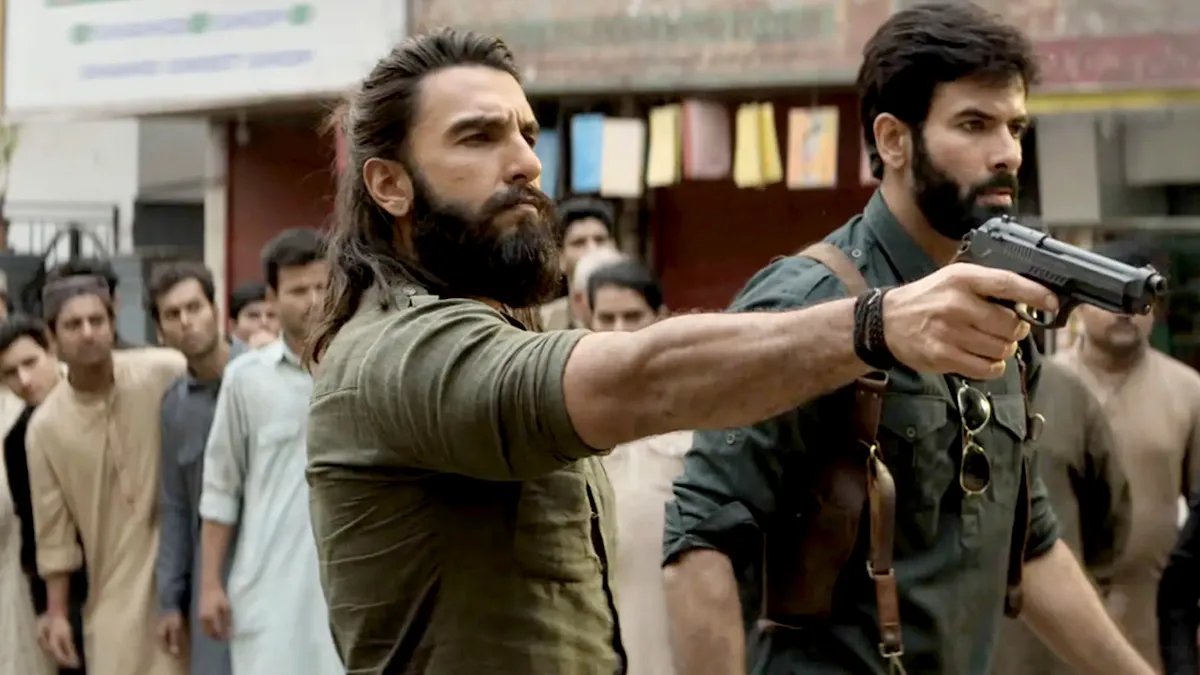
Dhurandhar‘s most concerning concept is Director Aditya Dhar’s vision of an Indian State controlled by an unaccountable deep state—an intelligence network beyond the reach of Parliament, courts, or voters, notes Syed Firdaus Ashraf.
IMAGE: Ranveer Singh in Dhurandhar.
Film Analysis
Watching Dhurandhar reveals numerous significant inconsistencies. As a journalist, it’s puzzling how these inaccuracies bypassed Director Aditya Dhar, known for his detailed research. Or perhaps, the inaccuracies were intentional, with historical accuracy not being the film’s primary focus.
Plot and Ideological Narrative
At its heart, Dhurandhar claims to tell the story of an Indian spy, portrayed by Ranveer Singh, who penetrates Karachi’s criminal underworld to eliminate threats against India. However, it projects an ideological narrative, advocating a strong, unaccountable intelligence system while subtly undermining India’s democratic institutions. The film leans towards propaganda, promoting the idea of a ‘deep state’ rather than presenting a realistic espionage thriller.
Initial Scene and Historical Inaccuracies
The film’s problems start from the first scene. Dhurandhar opens with blindfolded passengers on the hijacked Air India IC 814 at Kandahar. Basic research would have shown this portrayal is incorrect. During the 1999 IC 814 hijacking, most women and children were de-boarded in Dubai before the plane continued to Kandahar. Accuracy is a moral obligation when recreating real events.

IMAGE: R Madhavan in Dhurandhar.
Character and Ideological Bias
As the story progresses, it becomes apparent that Dhurandhar is more about the personal beliefs of a powerful intelligence officer, Ajay Sanyal (played by R Madhavan), than national security. Sanyal is portrayed as the ultimate judge of patriotism, morality, and national interest, overriding elected governments and democratic processes. His political biases are evident and form the film’s ideological backbone. The United Progressive Alliance government, led by Dr. Manmohan Singh in 2004 and 2009, is depicted as weak and unworthy of intelligence cooperation. The film suggests that national interest, as defined by this officer, overshadows the government’s mandate, a troubling premise in a democracy like India.
Real Events and Fictional Disclaimer
Dhurandhar begins with a disclaimer stating all characters and events are fictional, yet includes footage of the 26/11 Mumbai terror attacks. This selective realism is misleading and manipulative.

IMAGE: Akshaye Khanna in Dhurandhar.
Political Undertones and Omissions
The film’s disdain for the Congress-led UPA government is vindictive, with Ajay Sanyal expressing a desire for a ruler who would halt fake currency circulation and abattoirs. This retrospectively justifies the demonetisation and beef bans by BJP-ruled states. The film omits the significant role of Abu Jundal in the 26/11 attacks, ignoring the UPA government’s success in identifying, tracking, and extraditing him from Saudi Arabia. This omission does not align with the film’s narrative of a weak UPA government.
Allegations and Ideological Bias
The discussion on fake currency alleges that a minister and his son allowed counterfeit currency circulation from Pakistan, an unproven claim. The only person scrutinised was the then finance secretary, targeted after participating in Rahul Gandhi’s Bharat Jodo Yatra, highlighting the film’s ideological bias.
Conclusion
Dhurandhar is not just a flawed spy thriller but a cinematic manifesto promoting authoritarian instincts, undermining democratic legitimacy, and suggesting unelected power brokers know best for the nation. It blurs the line between patriotism and propaganda, using cinema’s power to normalise a ‘State within a State,’ a concerning trend.
Photographs curated by Manisha Kotian/Rediff